
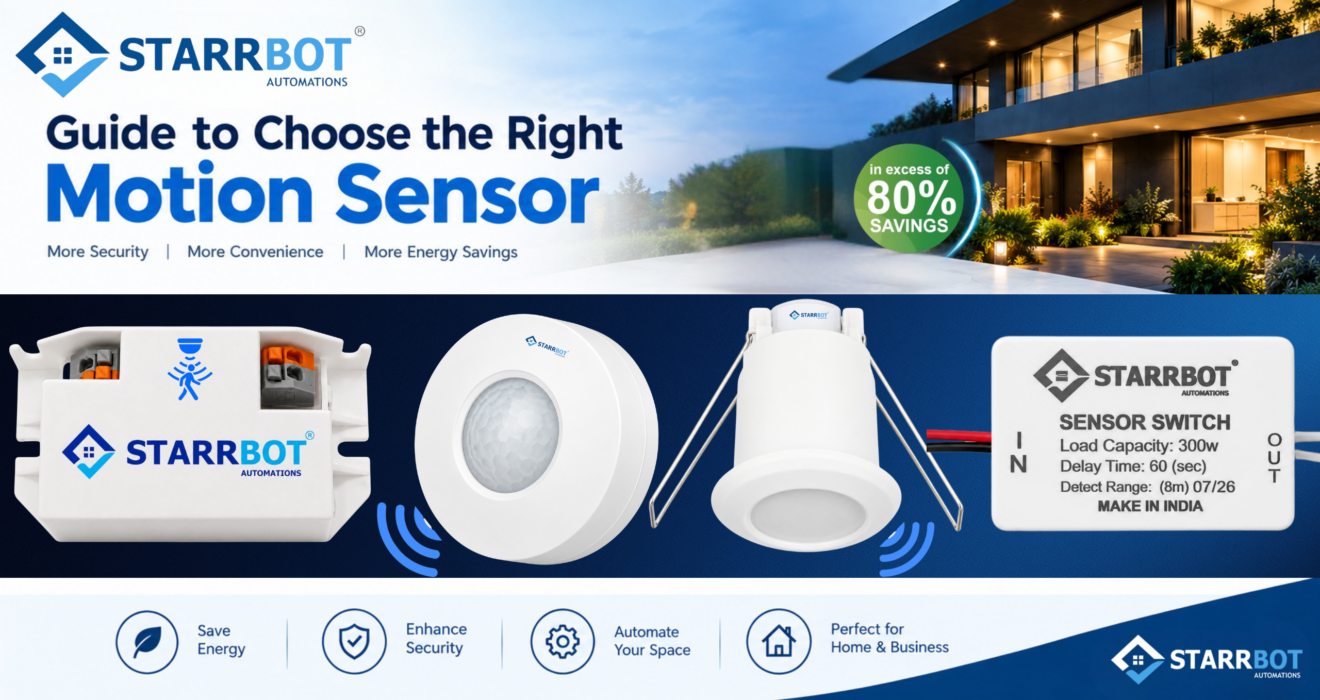
How to Choose the Right Motion Sensor for Your Space
Motion sensors are becoming an important part of modern lighting and automation. They can help automate lights, improve convenience and support better energy management in homes, offices, commercial buildings and outdoor areas.
However, different spaces need different types of sensors. Choosing the right motion sensor depends on factors such as detection range, application, mounting location and the type of movement you need to detect.
This blog post dives into the world of motion sensor, highlighting the importance of these sensors and introducing StarrBot as a reliable name in the industry.
Why Choose Motion Sensors?
Traditional lighting often depends on manual switches or fixed timers. Motion sensors make lighting smarter by allowing systems to respond to movement automatically.
Some key benefits include:
- ⚡ Better energy management
- 💡 Automatic lighting control
- 🏢 Convenient operation
- 🔄 Reduced unnecessary lighting
- 🛡️ Improved visibility and safety
- 🤖 Smart building automation
Types of Motion Sensors
Different sensor technologies are designed for different applications. Understanding their basic working can help you select the most suitable option.
1. PIR Motion Sensors
PIR (Passive Infrared) sensors detect changes in infrared radiation caused by moving people or objects.
They are commonly suitable for indoor applications such as:
- Offices
- Corridors
- Staircases
- Homes
- Washrooms
- Common areas
Best for: Reliable movement detection in typical indoor spaces.
2. Microwave Sensors
Microwave sensors use electromagnetic waves to detect movement. Depending on the sensor design, they can offer wide-area detection and can be useful for applications where more flexible detection is required.
They can be considered for:
- Parking areas
- Commercial spaces
- Large rooms
- Warehouses
- Industrial applications
Best for: Applications requiring wider or more sensitive motion detection.
3. Occupancy Presence Sensors
An Occupancy Presence Sensor is designed to detect whether a person is present in a space, including situations where there may be very little visible movement.

These sensors can be particularly useful in:
- Offices
- Meeting rooms
- Classrooms
- Cabins
- Smart homes
- Commercial spaces
Best for: Spaces where detecting occupancy is more important than detecting obvious movement.
4. Day-Night Sensors
Day-night sensing technology uses surrounding light levels to determine whether lighting should operate.
When combined with automatic lighting, it can help prevent lights from operating unnecessarily during daylight hours.
Best for: Outdoor areas, entrances, pathways, gardens and other spaces where ambient light changes throughout the day.
How to Select the Right Motion Sensor?
Before choosing a sensor, consider these important factors:
Application
First decide where the sensor will be installed. A corridor may require a different solution from a large parking area or an office cabin.
Detection Range
Check the required detection distance and coverage area. The sensor should be suitable for the size and layout of your space.
Mounting Location
Ceiling-mounted, wall-mounted and concealed installations may require different sensor designs.
Required Detection
Determine whether you need simple motion detection or more advanced occupancy/presence detection.
Lighting Requirement
If the sensor will control lighting, consider whether you need automatic ON/OFF, dimming or other smart lighting functions.
Motion Sensor Applications
Motion sensors can be used across many residential, commercial and industrial environments.
Common applications include:
- 🏠 Homes & Residential Societies
- 🏢 Offices
- 🚶 Corridors
- 🪜 Staircases
- 🅿️ Parking Areas
- 🏭 Industrial Spaces
- 🏫 Schools & Institutions
- 🏨 Hotels
- 🌳 Gardens & Outdoor Areas
STARRBOT Smart Sensor Solutions
STARRBOT AUTOMATIONS offers a range of sensor and smart lighting solutions designed for different applications.
From PIR Motion Sensors and Microwave Sensors to Occupancy Presence Sensors, STARRBOT solutions help businesses and communities move towards smarter automation and efficient lighting control.
The right sensor is not necessarily the most advanced one—it is the one that matches the space, application and detection requirement.
Conclusion
Choosing the right motion sensor starts with understanding your space and how the sensor will be used. PIR sensors can be suitable for many indoor applications, while microwave and occupancy sensing technologies can address different detection requirements.
With the right sensor and lighting combination, you can create a more automated, convenient and energy-efficient space.
STARRBOT – Smart Sensors. Smarter Lighting.