
How to Choose the Right Motion Sensor Light for Home
Walking into a dark hallway at 2 AM, fumbling for a switch — it is a scenario every Indian homeowner knows too well. Motion sensor lights eliminate this hassle entirely, turning on the moment they detect movement and switching off when you leave. Beyond convenience, they deliver meaningful energy savings and security benefits that regular fixtures simply cannot match.
But the market is flooded with options: PIR sensors, microwave sensors, different IP ratings, wattage choices, and power sources ranging from mains to solar. Choosing the wrong fixture means wasted money, false triggers, or a light that fails during monsoon season.
This guide walks you through every decision factor — sensor technology, room-wise light types, lumens, weatherproofing, power source, socket compatibility, Indian pricing, and installation tips — so you can pick the right motion sensor light with complete confidence.
TL;DR / Quick Answer
To choose the right motion sensor light for your home, match the sensor type to the room (PIR for indoor zones like wardrobes and corridors, microwave or dual-tech for large outdoor areas), select appropriate lumens per room size, verify an IP65+ rating for any outdoor fixture exposed to Indian monsoon conditions, and pick between mains, rechargeable, or solar power based on your installation location. Prioritise models with adjustable lux sensitivity and time-delay settings to prevent wasteful activations.
Why motion sensor lights make sense for Indian homes
Indian households waste significant electricity on lights that stay on in unoccupied rooms — staircases at midnight, bathrooms during daytime, and parking areas long after everyone has gone inside. Motion sensor lights solve this by activating only when someone is present. According to the U.S. Department of Energy’s Federal Energy Management Program (FEMP), occupancy-based lighting controls can reduce lighting energy consumption by 10% to 90% depending on the space and usage pattern, with documented savings of 29% in breakrooms and up to 54% in warehouses.
Beyond energy, there is a proven security angle. A randomized controlled experiment published by the National Bureau of Economic Research found that outdoor lighting reduced nighttime crimes by up to 59% in the study areas. For Indian homes with open gates, driveways, and compound walls, motion-activated security lighting deters intruders without keeping a floodlight burning all night. If you are exploring options for your home, Starrbot motion sensor lights offer a comprehensive range built for Indian residential conditions, and you can review their why choose Starrbot for motion sensor lights page for detailed value propositions.
PIR vs Microwave vs mmWave: pick the right sensor technology
The sensor inside your fixture determines how reliably it detects you, how far it sees, and how often it false-triggers. Passive Infrared (PIR) sensors detect body heat within a line-of-sight cone — typically 5 to 12 meters at a 90–180° angle — making them the most common and cost-effective choice for Indian bedrooms, corridors, wardrobes, and bathrooms. Microwave sensors emit radio waves that bounce back when interrupted, covering 20 meters or more with 360° detection, and they can sense motion through non-metallic walls and glass, which suits large driveways, parking lots, and warehouse yards. The trade-off: microwave units consume more standby power and can false-trigger on swaying branches or passing vehicles.
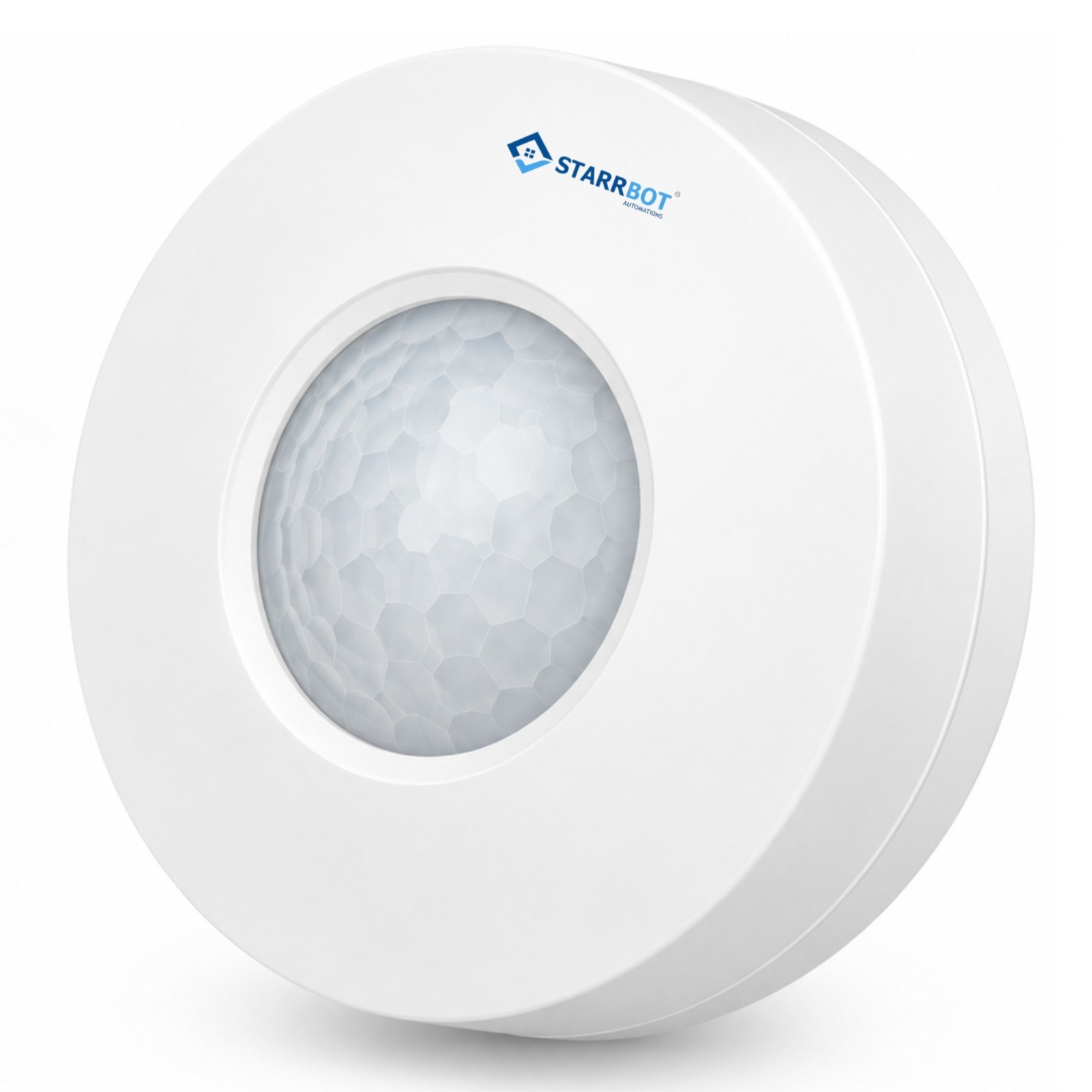
mmWave radar is the newest entrant, offering granular presence detection (including stationary breathing) at shorter ranges — ideal for smart offices and rooms where you want the light to stay on even when you sit still reading. For most Indian homes, a PIR-based sensor is the practical default; switch to microwave or dual-tech (PIR + microwave) only for large outdoor zones. You can explore Starrbot PIR and microwave motion sensors as standalone modules if you want to add detection capability to an existing fixture.
Match the light type to the room (wardrobe, staircase, bedroom, gate, parking)
Each room in an Indian home has different lighting needs. Wardrobes and kitchen cabinets work best with rechargeable strip or smart tube lights that mount inside and activate when the door opens. Staircases and corridors benefit from surface-mounted or concealed panel lights installed at mid-wall or ceiling height, casting even light across steps. Bedrooms and living rooms need surface panel lights or flush-mount ceiling fixtures with a wide detection cone so the light responds as you enter but does not blare in your eyes while sleeping.
For outdoor areas, the fixture type shifts entirely. Gates and driveways require flood lights or street lights with long-range PIR or microwave sensors and robust aluminium bodies. Gardens benefit from lower-wattage, IP-rated garden lights that accent pathways while detecting approaching movement. Parking areas and building perimeters are best served by bulk head lights or high bay lights depending on ceiling height. Browse the full range of Starrbot motion sensor lights to find room-specific options — from smart tube lights for wardrobes and kitchens to concealed panel lights for false ceilings.
Lumens and wattage chart for every room size
Wattage tells you power draw; lumens tell you brightness. For Indian rooms, here is a practical reference:
| Room / Area | Recommended Lumens | Approx. LED Wattage |
|---|---|---|
| Wardrobe / Cabinet | 100–200 lm | 3–5W |
| Bathroom / Toilet | 400–600 lm | 8–10W |
| Corridor / Staircase | 600–900 lm | 10–15W |
| Bedroom (10×12 ft) | 1,200–1,800 lm | 15–18W |
| Living Room (12×15 ft) | 1,800–2,400 lm | 18–24W |
| Outdoor Gate / Driveway | 2,000–4,000 lm | 20–50W |
| Parking / Compound | 3,000–6,000 lm | 36–72W |
Colour temperature also matters: 2700K warm white suits bedrooms and living rooms, 4000K neutral white fits kitchens and bathrooms, and 6500K daylight works for outdoor security. For larger indoor spaces, Starrbot 2×2 auto-dimmable panel lights deliver broad, even illumination with built-in dimming based on ambient light, while Starrbot COB lights provide focused spotlighting for accent or task areas.
IP rating and weatherproofing for Indian outdoor conditions
IP (Ingress Protection) ratings tell you how well a fixture resists dust and water. The first digit (0–6) rates dust protection; the second digit (0–9K) rates water resistance. For Indian outdoor conditions — where monsoon rain, dust storms, and coastal humidity are common — IP65 is the practical minimum for any fixture exposed to open air. IP65 means complete dust-tight protection and resistance to water jets from any direction. Covered balconies and semi-outdoor porches can manage with IP44, but anything under direct rain or near sprinklers should be IP65 or higher.
Indian heat also matters: a fixture rated for temperate climates may warp or yellow under 45°C summers. Look for polycarbonate or aluminium bodies with UV-stabilised lenses. The Starrbot outdoor motion sensor flood lights and Starrbot motion sensor street lights for gates and parking feature aluminium construction and weather-sealed sensor housings designed for Indian outdoor exposure, while Starrbot motion sensor garden lights in 15W and 20W variants provide pathway illumination rated for year-round outdoor use.
Battery, rechargeable, mains or solar — power source decision
Your power source depends on installation location and wiring access. Mains-powered (wired) fixtures deliver the most consistent brightness and unlimited runtime — ideal for ceiling-mounted indoor panels, outdoor flood lights, and street lights where wiring already exists. Battery or rechargeable units suit wardrobes, cabinets, and retrofit spots with no nearby wiring; they are easy to install with adhesive or screws but require periodic recharging every few weeks depending on usage frequency.
Solar-powered motion sensor lights work well for gates, compound walls, and garden paths where running electrical conduit is impractical. The caveat: solar panels need 4–6 hours of direct sunlight daily, and output drops during monsoon months in states like Kerala, Maharashtra, and West Bengal. For warehouses, factories, or high-ceiling commercial spaces with existing wiring, Starrbot high bay lights for high-ceiling spaces deliver mains-powered, motion-activated illumination without the runtime limitations of battery units. Budget ₹2,000–5,000 for mains-powered residential fixtures and ₹800–2,000 for rechargeable units in India.
Time delay, lux sensor and detection range: must-have settings
Three adjustable settings separate a good motion sensor light from one that frustrates you. Time delay controls how long the light stays on after the last detected movement — set it to 15–30 seconds for corridors and bathrooms, 1–3 minutes for staircases, and 5–10 minutes for outdoor parking. Too short and the light flickers off mid-walk; too long and you lose the energy-saving benefit.
A lux (daylight) sensor prevents the light from turning on when there is already sufficient ambient light. This is critical for south-facing balconies and well-lit kitchens — without it, the sensor fires needlessly during daytime. Detection range determines how far the sensor reaches: 3–6 meters is sufficient for wardrobes and bathrooms, while 8–12 meters suits corridors and outdoor driveways. For Indian homes with ceiling fans and AC vents, set detection range conservatively to avoid air-movement false triggers. Models with all three adjustable settings — time delay, lux threshold, and range — give you the flexibility to fine-tune performance room by room.
B22 vs E27 socket and retrofit bulb compatibility
Most Indian homes use B22 (bayonet cap) bulb holders, while newer fixtures and imported smart bulbs sometimes use E27 (Edison screw). Before buying a motion sensor bulb, check which socket your existing holder uses — a mismatch means an immediate return or an adapter purchase. B22 motion sensor bulbs are widely available for ₹500–1,200 and screw directly into existing holders, making them the easiest retrofit option for Indian bedrooms, bathrooms, and corridors.
E27 motion sensor bulbs offer a wider range of wattages and smart features but require either an E27 holder or a B22-to-E27 adapter (₹50–100). If you are replacing a complete fixture rather than just the bulb, socket compatibility becomes irrelevant — you are installing a new unit with its own integrated LED module. For integrated sensor lighting that eliminates socket concerns altogether, consider Starrbot smart LED lights with motion sensor, which combine sensor, driver, and LED panel into a single flush-mount unit suitable for Indian false ceilings and standard wiring.
Top picks under ₹1,500 / ₹3,000 / ₹5,000 with Indian warranty
Budget is the deciding factor for most Indian buyers. Under ₹1,500, you will find rechargeable stick-on LED panels (3–5W) for wardrobes and bathrooms, and basic PIR sensor bulbs in B22 or E27 bases. These work fine for small spaces but lack adjustable lux and range settings.
Between ₹1,500 and ₹3,000, expect mains-powered PIR wall or ceiling panels (10–18W) with adjustable time delay and lux sensors — suited for bedrooms, corridors, and covered balconies. Starrbot’s outdoor garden lights start in this range with 15W and 20W variants featuring auto-dimming and weather-rated bodies.
Above ₹3,000 and up to ₹5,000, you get high-output outdoor flood lights, street lights (36–50W), and premium 2×2 panel lights with integrated microwave or dual-tech sensors. Always verify warranty terms — look for at least 1–2 years of manufacturer coverage. Top Starrbot picks come with up to 5-year warranty support, and you can register your Starrbot warranty online after purchase for hassle-free claims. ISO 9001:2015 certified manufacturing further assures consistent quality across the range.
Installation height, angle and how to stop false triggers in Indian homes
Mounting height directly impacts detection accuracy. For indoor ceiling-mounted PIR units, 8–10 feet is ideal — high enough to cover the room, low enough for the sensor to register body heat clearly. Wall-mounted units at 6–7 feet with a slight downward tilt (10–15°) work for corridors and staircases. Outdoor flood lights should sit at 10–12 feet, angled slightly downward to avoid detecting passing traffic on adjacent roads.
False triggers are the most common complaint among Indian users. The top culprits: ceiling fans stirring warm air near PIR sensors, AC vents blowing cold air across the detection cone, curtains moving near open windows, and pets crossing the sensor field. Solutions include reducing detection range, angling the sensor away from fans and AC outlets, and choosing models with pet-immunity or dual-tech confirmation. For commercial installations or multi-room projects where false-trigger calibration is critical, consult the Starrbot clients and projects across India to see how large-scale deployments handle sensor placement in diverse Indian building types.
Energy savings calculator: annual ₹ vs normal LED
Here is a simple way to estimate savings. A standard 15W LED tube running 10 hours daily consumes 0.15 kWh per day — roughly 54.75 kWh per year. At an average Indian residential tariff of ₹7 per unit, that costs ₹383 annually per fixture. A motion sensor equivalent in the same corridor activates only when occupied — typically 2–3 hours daily in a household — bringing consumption down to roughly 11–16.5 kWh per year, or ₹77–₹116 per fixture.
Scale that across a typical 2BHK Indian home with 8–10 light points, and annual savings range from ₹2,000 to ₹3,500 compared to always-on LEDs — and far more if you are replacing incandescent or CFL fixtures. The payback period for motion sensor lights typically falls within 12–24 months. Starrbot’s up to 80% energy savings positioning aligns with these real-world figures, making the switch a financially sound decision for both homeowners and facility managers looking at long-term operational costs.
Final checklist before you buy
Before you place your order, run through this checklist. First, confirm sensor type: PIR for most indoor rooms, microwave or dual-tech for large or outdoor spaces. Second, verify lumens and wattage match your room size using the chart above. Third, check IP rating — IP65 minimum for anything exposed to rain or dust. Fourth, choose your power source: mains for permanent installations, rechargeable for retrofit spots, solar for areas without wiring. Fifth, confirm socket compatibility (B22 vs E27) if buying a retrofit bulb. Sixth, ensure adjustable time delay, lux sensor, and range are available on the model you select. Seventh, compare warranty coverage and manufacturer credentials.
If you have questions or need project-specific recommendations, Starrbot FAQs on motion sensor lights cover common buying queries. For bulk orders, commercial projects, or custom specifications, you can get a bulk or project estimate from Starrbot or contact Starrbot at +91 8329415737. Dealers and electricians interested in distribution can also become a Starrbot dealer for access to the full product portfolio and trade pricing.
Frequently Asked Questions
What is a motion sensor light and how does it work for home use?
A motion sensor light is a lighting fixture with a built-in sensor that detects movement — typically using Passive Infrared (PIR) or microwave technology — and automatically turns the light on when someone enters the detection zone, then switches off after a preset time delay when the area is vacated.
PIR vs microwave sensor: which one is better for Indian homes?
PIR sensors are better for most Indian indoor rooms like bedrooms, corridors, and bathrooms because they are affordable, energy-efficient, and detect body heat within 5–12 meters. Microwave sensors suit large outdoor areas like driveways and parking lots where longer range and obstacle penetration are needed.
What IP rating should I look for in an outdoor motion sensor light in India?
For Indian outdoor conditions, IP65 is the recommended minimum. IP65-rated fixtures are fully dust-tight and can withstand water jets from any direction, making them suitable for monsoon rain, dust storms, and coastal humidity.
How much electricity can a motion sensor light save compared to a regular LED?
Motion sensor lights can save 50–80% of lighting energy compared to always-on LEDs in spaces like corridors, bathrooms, and parking areas, since the fixture only operates when motion is detected. The payback period is typically 12–24 months.
Can I fit a motion sensor light into my existing B22 bulb holder at home?
Yes, motion sensor bulbs with a B22 bayonet cap are widely available and fit directly into standard Indian bulb holders without any rewiring. For E27 holders, use a B22-to-E27 adapter or choose an E27-compatible sensor bulb.
Why do motion sensor lights false-trigger with ceiling fans in Indian rooms?
PIR sensors detect heat signatures, and ceiling fans circulate warm air across the detection cone, causing the sensor to register movement. The fix is to reduce the detection range, angle the sensor away from the fan, or choose a model with adjustable sensitivity settings.
What is the ideal installation height for a motion sensor light on a staircase?
For wall-mounted motion sensor lights on staircases, install at 6–7 feet from the step level with a slight downward tilt of 10–15 degrees. This angle ensures the PIR sensor detects people walking up and down without picking up false signals from adjacent rooms.
How long do motion sensor lights last in Indian weather conditions?
Quality LED motion sensor lights are rated for approximately 50,000 LED life hours, which translates to 10–15 years of typical residential use. Outdoor models with aluminium bodies and IP65 sealing maintain performance through Indian heat, monsoon, and humidity.