
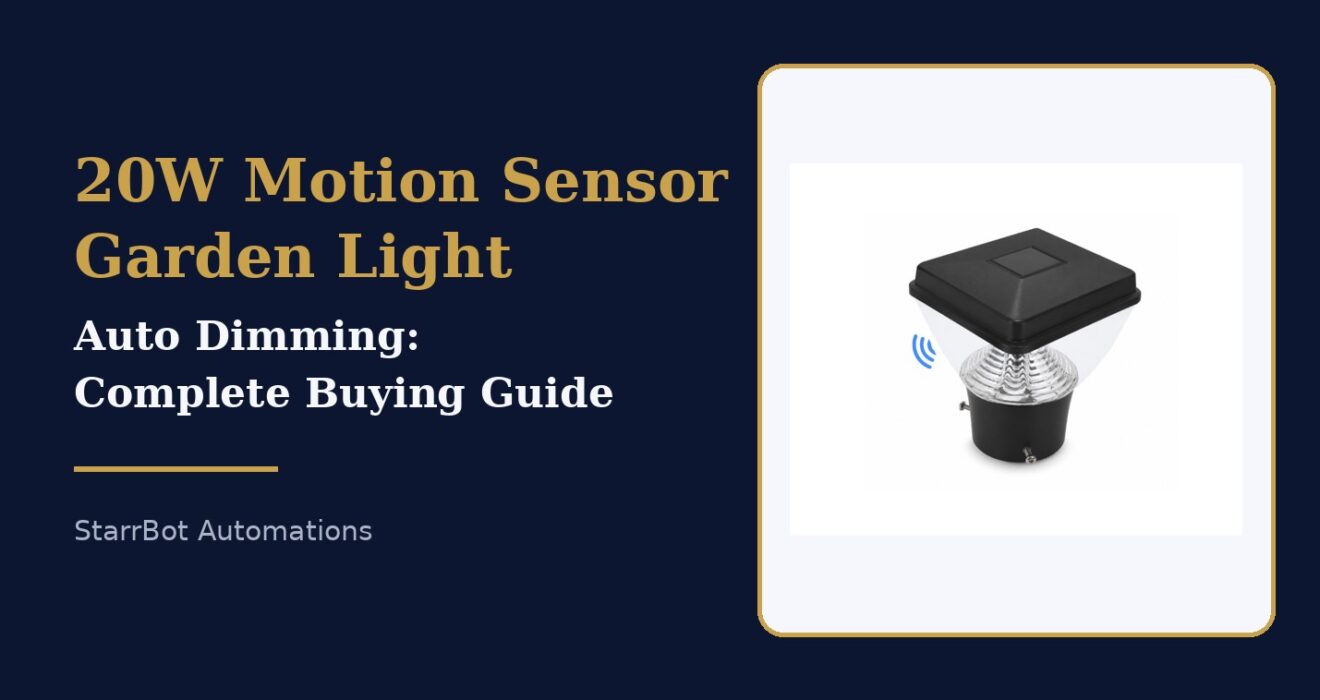
20W Motion Sensor Garden Light with Auto Dimming: The Complete Buying Guide for India (2026)
Garden lighting has come a long way from simple wall-mounted fixtures that stayed on all night, burning through electricity bills month after month. Today, a single motion sensor garden light 20W unit can illuminate your driveway, pathway, or backyard the moment someone steps within range — and dim itself back down when nobody’s around. That’s not a future concept; it’s what modern sensor-based LED fixtures already deliver, and it’s exactly why homeowners, housing societies, and facility managers across India are switching to these intelligent lights.
In this guide, we’ll walk you through how auto-dimming technology works, the specifications you should compare before buying, the real energy savings you can expect (backed by peer-reviewed research), and how to pick the right fixture for your space. Whether you’re lighting a residential garden or a commercial campus, this article covers everything you need to make a smart purchase decision in 2026.
TL;DR / Quick Answer
A 20W motion sensor garden light combines a high-efficiency LED array with a built-in passive infrared (PIR) or microwave sensor that detects movement and auto-dims the output from 100% to 15% when no motion is present. This design can reduce outdoor lighting energy consumption by up to 86% compared to always-on fixtures (Sensor Switch / Acuity Brands). The Starrbot 20W motion sensor garden light ships with integrated dusk-to-dawn sensing and is priced at Rs. 1,836.75 (MRP Rs. 2,449) inclusive of all taxes — making it one of the most cost-effective options in the Indian market.
What Is a 20W Motion Sensor Garden Light?
A motion sensor garden light is an outdoor-rated LED fixture that pairs a low-wattage light engine with an integrated occupancy or motion detector. The “20W” designation tells you the LED module draws 20 watts of electrical power at peak output — a sweet spot that delivers enough lumens for driveways, garden paths, patios, and building perimeters without the overkill (and higher cost) of a 50W or 100W street light. When nobody is nearby, the sensor holds the luminaire at a low standby brightness; the instant it detects movement, the light ramps up to full output, then dims back down after a preset hold-time.
This approach matters because garden fixtures run for an average of 10–12 hours every night. Under a traditional always-on scenario, a 20W fixture consumes 0.24 kWh per night, or roughly 87.6 kWh per year. With auto dimming at a 15% standby level, total annual energy consumption drops dramatically — and that’s before you factor in the extended LED lifespan that comes from running at reduced power for most of the night. The full motion sensor garden light range at Starrbot covers both 15W and 20W variants for spaces of different sizes.
How Auto Dimming Technology Works in Garden Lights
Auto dimming in a motion sensor garden light operates on a simple but effective two-layer control system. The first layer is a dusk-to-dawn photocell sensor that detects ambient light levels — once natural daylight fades below a preset threshold (typically 30–50 lux), the fixture arms itself and waits. The second layer is the motion detector — usually a PIR (passive infrared) sensor — that monitors the surrounding zone for heat signatures from people, vehicles, or animals. When motion is detected, the driver floods the LED array at 100% output. Once the zone clears, the driver steps the brightness back down to a dimmed standby level — commonly 10% to 20% — and holds it there until the next trigger event.
This layered logic is critical for energy performance. A 2025 peer-reviewed study published in Nature Scientific Reports found that an ambient-light-based automatic dimming system reduced LED power consumption by 75.65% compared to standard always-on lamps. Separately, Sensor Switch’s industry-standard Motion Sensing Guide for outdoor LED luminaires reports that multi-level occupancy sensors can save up to 86% in energy versus standard LED operation when the light is in its dimmed standby state. The Starrbot motion sensor lights range uses this same auto-dimming architecture, dropping brightness from 100% to 15% when no motion is detected — a design aligned with the latest international efficiency standards.
Technical Specifications to Evaluate Before You Buy
When comparing any motion sensor garden light 20W product, start with five metrics: luminous efficacy (lumens per watt), colour temperature (CCT), IP rating, sensor detection range, and standby dimming level. In 2026, a good 20W LED garden light should deliver at least 100 lm/W — roughly 2,000 lumens total — in a warm-white 3000K–4000K CCT that complements outdoor landscaping rather than creating a harsh industrial glare. An IP65 or higher ingress-protection rating is essential because garden fixtures face direct rain splash, dust, and insect intrusion. PIR sensor detection ranges typically fall between 6 and 12 metres at a 2.5 m mounting height, which is the standardised measurement approach defined in EN IEC 63180:2020/A1:2025 — the latest international PIR testing standard published in 2025.
Beyond those basics, check the dimming level and the hold-time. California’s Title 24 §130.2(c)3 mandates that outdoor luminaires installed at or below 24 feet must reduce output by 40–90% when no occupancy is detected — regulations that influence global product design. The DLC LUNA V1.0 specification (March 2025) further requires continuous dimming down to below 20% of maximum output for dark-sky-qualified luminaires. For projects requiring either PIR or microwave detection, you can explore Starrbot PIR and microwave motion sensors — the S-24 (PIR infrared) and S-29 (microwave) modules — to match the right detector technology to your site conditions.
Energy Savings, ROI & Industry Trends in 2026
The numbers make a compelling case for adopting auto-dimming garden lights. According to the Outdoor Motion Sensor Lights Market report (updated 2026) by Strategic Market Research, the global market was valued at USD 2.4 billion in 2025 and is projected to reach USD 4.1 billion by 2032 at an 8.1% CAGR. The pathway and landscape lighting segment — which directly covers garden fixtures — accounts for a 21% market share (USD 504 million) with the same 8.1% compound annual growth, while the overall residential segment leads demand at 46% market share. These figures confirm that intelligent garden lighting isn’t a niche product; it’s the fastest-growing sub-segment in outdoor LED.
For individual buyers, the ROI math is straightforward. A continuously running 20W garden light costs approximately Rs. 700–900 per year in electricity at typical Indian residential tariffs (Rs. 7–8 per kWh). An auto-dimming model operating at 15% standby for roughly 80% of the night cuts that annual bill to Rs. 200–300 — a 60–70% reduction. Over a 50,000-hour LED lifespan, that translates into thousands of rupees saved per fixture. Virginia Tech’s adaptive-lighting field deployment in Cambridge, NE, demonstrated 55% energy savings in the initial year. Combined with Starrbot’s 10+ years in motion sensor lighting and ISO 9001:2015 manufacturing certification, the brand positions its 20W garden light as a performance-verified upgrade for cost-conscious Indian buyers.
Best Applications for 20W Motion Sensor Garden Lights
A 20W output is versatile enough for a surprisingly wide range of outdoor settings. Residential homeowners use these fixtures along garden pathways, around swimming pools, on compound walls, and near garage driveways — any zone where bright light is needed on demand rather than all night. Housing societies and apartment complexes install 20W units across common walkways, stairwell perimeters, and basement entry ramps where continuous illumination is both wasteful and unnecessary. In commercial and light-industrial environments, 20W garden lights work well for loading-bay perimeters, entrance lobbies, campus pathways, and warehouse boundary walls where security-grade visibility matters only during actual presence.
Scale these deployments across multiple fixtures and the aggregate savings become significant. With 1500+ completed lighting projects across India, Starrbot has supplied sensor-based garden and street lights for gated communities, corporate campuses, factories, and municipal park installations. For large-area or infrastructure buyers exploring bulk supply, it’s worth requesting a project estimate for volume-tier pricing on 20W garden lights alongside higher-wattage street and flood light models. Dealers and regional distributors looking to add motion sensor lighting to their product catalogue can also explore partnership opportunities to serve the growing residential and commercial demand.
Installation and Maintenance Tips
Installing a 20W motion sensor garden light is simpler than most homeowners expect, but a few best practices ensure reliable long-term performance. Mount the fixture at a height between 2.5 and 3 metres — this is the height range at which most PIR sensors are tested and rated for their declared detection area. Angle the sensor lens toward the approach zone rather than across open sky; pointing a PIR sensor at a busy road or a neighbour’s garden will cause false triggers and shorten the lamp’s effective dimming cycle. Run a quick test walk-through at dusk after installation to confirm trigger distance, hold-time, and dimming depth are matched to actual site conditions.
On the maintenance side, LED garden lights with PIR sensors require minimal upkeep, but periodic sensor lens cleaning removes dust, cobwebs, and water spots that can degrade detection sensitivity. Check wiring connections once a year, especially after monsoon season, and ensure the photocell window isn’t blocked by encroaching foliage or mounting hardware. For product-specific troubleshooting tips, the Starrbot motion sensor light FAQs page covers common questions on sensor calibration, dimming modes, and warranty support. After purchase, always register your product warranty to activate coverage, and contact Starrbot on +91 8329415737 for any technical or dealer support queries.
How to Choose the Right Motion Sensor Garden Light
Start with your site requirements, not the spec sheet. Map out the area you need to cover and identify the mounting surface — a wall, a pole, or a canopy. A 20W fixture works best for zones within a 10–12 metre detection radius at standard mounting heights; if you need 20+ metre coverage, step up to a 36W or 50W street light model instead. Next, decide between PIR and microwave sensor technology. PIR sensors (like the S-24) detect body-heat infrared radiation and perform well in standard outdoor applications. Microwave sensors (like the S-29) emit low-power radio waves and can detect motion through thin partitions or glass — a useful advantage for semi-enclosed patios and covered walkways.
Finally, compare build quality, warranty, and brand support before finalising your purchase. Look for an aluminium or die-cast housing with IP65-rated sealing, a driver with built-in surge protection, and an LED driver rated for at least 50,000 hours. The Starrbot 20W Motion Sensor Garden Light checks all of these boxes at a currently discounted price of Rs. 1,836.75 (MRP Rs. 2,449, inclusive of all taxes). If you’re evaluating the full range before committing, you can understand why Starrbot leads in motion sensor lighting by reviewing their R&D approach, 1 Lakh+ customer base, and 50,000-hour LED life rating across the product line.
Conclusion
A motion sensor garden light 20W fixture with auto dimming is one of the simplest upgrades you can make to outdoor spaces — delivering meaningful energy savings, hands-free convenience, and improved security without complex wiring or smart-home integrations. The technology is proven, the global market is growing at 8.1% CAGR, and Indian buyers now have access to ISO-certified, performance-tested options at sub-Rs. 2,000 price points.
If you’re ready to replace your always-on garden lights with an intelligent alternative, evaluate your site layout, choose the right sensor type, and invest in a quality fixture backed by strong warranty and dealer support.
Ready to get started? Explore the full Starrbot motion sensor garden light range, request a bulk estimate, or call +91 8329415737 for a product consultation tailored to your project.
Frequently Asked Questions
What is a 20W motion sensor garden light?
A 20W motion sensor garden light is an outdoor LED fixture rated at 20 watts that integrates a PIR or microwave motion sensor to automatically switch to full brightness when movement is detected and dim down to a standby level — typically 10–20% — when the area is unoccupied, combining energy efficiency with hands-free convenience.
How much energy does a 20W motion sensor garden light save?
Auto-dimming motion sensor lights can save up to 60–86% of energy compared to continuously running fixtures, according to industry research. The actual savings depend on how frequently the area sees traffic and the dimming standby percentage; typical residential garden installations in India report a 50–70% reduction in outdoor lighting electricity costs.
What is the detection range of a PIR motion sensor in garden lights?
At a standard wall-mount height of 2.5 metres (per EN IEC 63180:2020/A1:2025 testing methodology), most PIR sensors in 20W garden lights detect motion within a 6–12 metre radius. Detection angle, ambient temperature, and sensor lens quality all influence effective range.
What is the difference between auto dimming and auto on/off in garden lights?
Auto dimming reduces the light to 10–20% output during standby, maintaining a baseline glow overnight. Auto on/off switches the light completely off (0%) when no motion is detected and turns it on only when triggered. Auto dimming provides a subtle ambient light and quicker ramp-up, while auto on/off maximises energy savings.
Can I use a 20W motion sensor garden light for outdoor security?
Yes. A 20W fixture provides approximately 2,000 lumens at full output — sufficient for driveway, pathway, and perimeter security lighting in residential and small commercial settings. Pairing multiple 20W units with overlapping sensor zones creates an effective security-lighting grid without the cost of higher-wattage flood lights.
How long does a 20W LED garden light last?
Quality 20W LED garden lights are rated for 50,000 operational hours. In a garden application with auto dimming (where the LED runs at reduced power for roughly 80% of the night), this rating effectively translates to 10–12 years of service before the LED module reaches end-of-life.
Suggested Internal Links Used:
| Anchor Text | URL | Section Used |
|---|---|---|
| Starrbot 20W Motion Sensor Garden Light | https://starrbot.com/ | Introduction / How to Choose |
| full motion sensor garden light range | https://starrbot.com/product-category/sensor-lights/garden-light/ | What Is a 20W Motion Sensor Garden Light? / Conclusion |
| Starrbot motion sensor lights | https://starrbot.com/product-category/sensor-lights/ | How Auto Dimming Technology Works |
| explore Starrbot PIR and microwave motion sensors | https://starrbot.com/product-category/sensors/ | Technical Specifications |
| 1500+ completed lighting projects | https://starrbot.com/clients/ | Best Applications |
| request a project estimate | https://starrbot.com/get-estimate/ | Best Applications |
| Starrbot’s 10+ years in motion sensor lighting | https://starrbot.com/about/ | Energy Savings, ROI & Industry Trends |
| why choose Starrbot for motion sensor lighting | https://starrbot.com/why-starrbot/ | How to Choose |
| Starrbot motion sensor light FAQs | https://starrbot.com/faqs/ | Installation and Maintenance |
| register your product warranty | https://starrbot.com/warranty-registration/ | Installation and Maintenance |
| contact Starrbot on +91 8329415737 | https://starrbot.com/contact-us/ | Installation and Maintenance |
Suggested External References:
| Source Title | Publisher | URL | Reason Used |
|---|---|---|---|
| Outdoor Motion Sensor Lights Market Report (Updated 2026) | Strategic Market Research | https://www.strategicmarketresearch.com/market-report/outdoor-motion-sensor-lights-market | Market size ($2.4B) and CAGR data validating garden light segment growth |
| An approach to energy conservation in lighting systems using luminaire-based sensor for automatic dimming | Nature Scientific Reports | https://www.nature.com/articles/s41598-025-87813-y | 75.65% energy reduction from auto-dimming peer-reviewed study |
| Motion Sensing Guide for Outdoor LED Luminaires | Sensor Switch (Acuity Brands) | https://pdmassets.azureedge.net/library/LL/documents/specsheets/Motion%20Sensor%20Guide.pdf | Up to 86% energy savings with motion sensing vs standard LED |
| EN IEC 63180:2020/A1:2025 PIR Detector Test Methods | IEC / CENELEC | https://standards.iteh.ai/catalog/standards/clc/001d02e0-c237-42d6-900d-0b05dbbf0326/en-iec-63180-2020-a1-2025 | Latest PIR sensor range testing standard for spec credibility |
| California Title 24 §130.2(c)3 | California Energy Commission | https://www.energy.ca.gov/sites/default/files/2020-06/2016_Nonresidential_Lighting_ada.pdf | 40–90% mandated dimming requirement for outdoor luminaires |
| DLC LUNA Technical Requirements V1.0 (March 2025) | DesignLights Consortium | https://designlights.org/wp-content/uploads/2025/03/DLC_LUNA-Technical-Requirements-V1-0_03072025.pdf | <20% dimming requirement for dark-sky qualification |
| Adaptive lighting for streets and residential areas (Virginia Tech) | U.S. DOE / OSTI | https://www.osti.gov/biblio/2569693 | Field data: 55% energy savings in adaptive lighting deployment |