
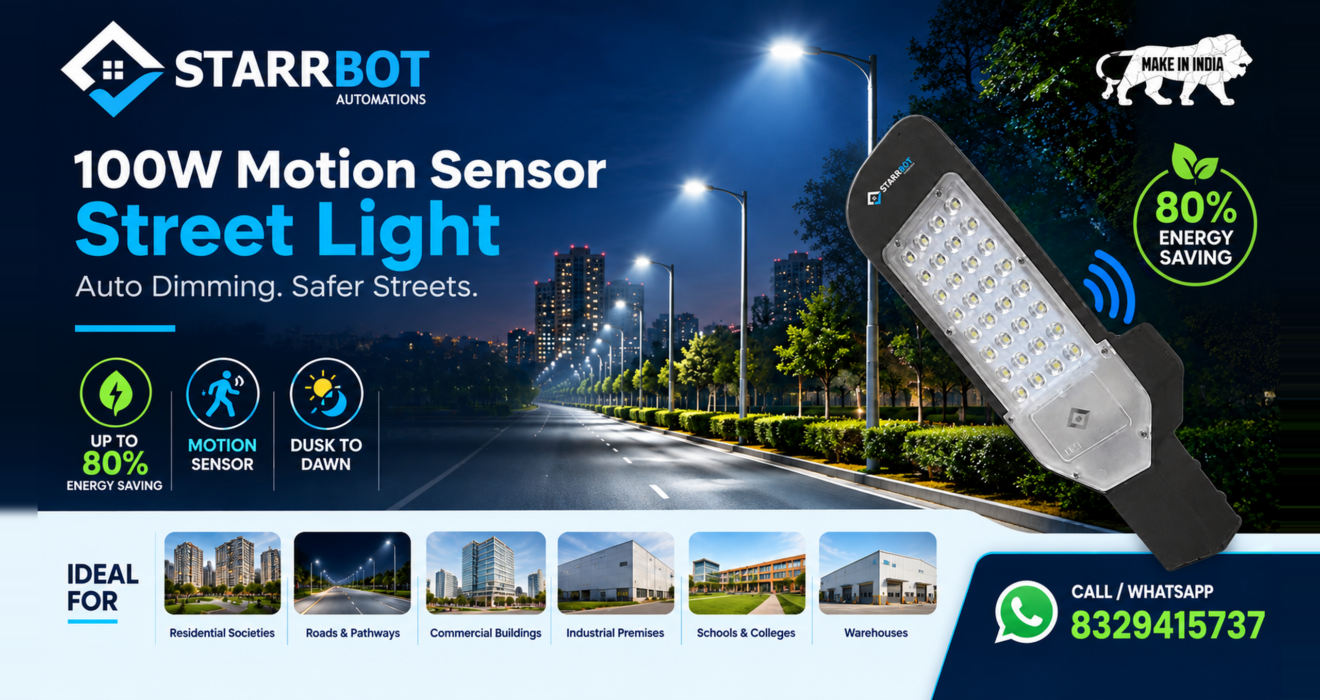
100W Motion Sensor Street Light with Auto Dimming: The Complete 2026 Buying Guide
Outdoor lighting is a steady electricity cost for housing societies, factories, warehouses and campuses. Most of that power is wasted in the quiet hours of the night, when nobody is on the road to use the light. A 100W motion sensor street light fixes this. It stays at a low level when the area is quiet and brightens when it detects movement.
This guide explains how it works, which specifications to check, how much energy it can save, where it fits best and how to choose and install the right model. It is written for facility managers, society committees and project buyers in India.
Quick Answer
A 100W motion sensor street light is an LED street light with a built-in motion sensor and LED driver. It uses 2-step dimming: lower brightness when nothing is moving, full brightness when movement is detected. Starrbot motion sensor street lights can save up to 80% energy, with wattage options starting from 24W, an aluminium body and up to 50,000 hours of rated life. They are designed for mounting heights of 5 to 8 metres and detect motion up to 10 metres away.
Table of Contents
- What Is a 100W Motion Sensor Street Light?
- How Auto Dimming Works
- Key Specifications to Compare
- Energy Savings
- Best Applications
- How to Choose and Install the Right Model
- FAQs
What Is a 100W Motion Sensor Street Light?
A 100W motion sensor street light is an outdoor LED luminaire for roads, pathways, compound walls and perimeters. It pairs a 100-watt LED light source with an integrated motion sensor. The sensor watches the area in front of the light. When it detects a person or a vehicle, the light goes to full brightness. When the area is quiet again, it returns to a lower level, so the light is not wasting full power all night.
This is different from an ordinary dusk-to-dawn LED street light, which runs at the same brightness all night. A motion sensor street light adjusts to what is actually happening on the road. That is why it suits places where traffic is sporadic after dark, such as residential colonies, factory compounds and warehouse yards.
The Starrbot 100W Motion Sensor Street Light has an aluminium body, auto dimming and a wall fitting, and comes in Cool White, Natural White and Warm White. Starrbot is an Indian manufacturer of motion sensor lights and sensors. You can read more on the About Starrbot and Why Starrbot pages.
How Auto Dimming Works
The working is simple:
- The built-in sensor keeps watching its detection area.
- When it detects movement, the light goes to full brightness.
- When there is no movement for a while, the light dims again.
Starrbot street lights use 2-step dimming. That means two brightness levels: a lower level for idle time and full brightness for activity. The sensor and the LED driver are built into the fixture, so there is no separate controller to buy or wire. The detection range is up to 10 metres.
Two sensor technologies are common in motion lighting. A PIR (passive infrared) sensor picks up the heat of people and vehicles and works well for pathways and internal roads. A microwave sensor uses radio waves, and it is often chosen for wider areas. Starrbot makes both kinds. See the Starrbot sensors range for PIR and microwave options. Confirm the sensor type of the exact model you plan to buy before you order.
Key Specifications to Compare
Check these points when you compare quotes for a motion sensor street light:
| Specification | What to check |
|---|---|
| Wattage | Match to pole height and area. Starrbot wattage options start from 24W |
| Mounting height | 5 to 8 metres for Starrbot street lights |
| Detection range | Up to 10 metres |
| Dimming | 2-step dimming (low level and full brightness) |
| Body | Aluminium body for outdoor use |
| Rated life | Up to 50,000 hours |
| Safety | Single-end power supply, anti-electric shock design |
| Colour | Cool White, Natural White or Warm White |
| Warranty | Ask for the written terms. See the Starrbot warranty guidelines |
Also look for a high-quality optical design that gives even light with low glare. Poor optics can leave dark patches on the road or blind drivers, even when the wattage is right.
Energy Savings
The saving comes from the gap between rated power and what the light actually uses over a night. A fixed street light runs at full brightness for every hour it is on. A motion sensor street light spends most of the night at the lower level and reaches full brightness only when someone is there.
Starrbot motion sensor lights can save up to 80% energy. The exact saving in your project depends on how busy the area is, how long the light stays bright after movement and the dimming level. A quiet internal road will save more than a busy gate. Because the light also runs cooler at lower power, you can expect less stress on the driver over time.
To estimate your own saving, note the number of lights, the hours they run each night, your electricity tariff and how many hours of real activity you see after dark. Starrbot’s team can help you work this out for your site on the contact page.
Best Applications
A 100W motion sensor street light fits any outdoor area where activity is on and off through the night. The most common uses are:
- Internal roads in residential societies, campuses and industrial parks.
- Factories and warehouses, where the sudden brightness also discourages intruders.
- Compound walls and perimeters that need security lighting with low running cost.
- Offices and institutions, including schools, colleges and hospitals.
- Parking areas and walkways with occasional traffic.
For indoor and semi-outdoor areas, Starrbot also makes motion sensor lights in other formats, such as flood lights, high bay lights and garden lights.
How to Choose and Install the Right Model
1. Start with the pole height. Starrbot street lights are made for 5 to 8 metre mounting heights. If your poles are much higher or lower, discuss it with the supplier before you buy.
2. Pick the wattage for the area. A 100W light suits wider internal roads and larger yards. Lower wattages, starting from 24W, suit pathways, small compounds and lanes. Higher wattages suit wider roads.
3. Match the sensor to the place. PIR is good for pathways and internal roads. For wide open areas, ask about a microwave sensor.
4. Check the dimming behaviour. Confirm that the light dims to a level that suits your security needs.
5. Plan the installation. The light is a single unit with the sensor and driver built in, so wiring is the same as for a regular street light: live, neutral and earth through a properly rated MCB. Always use a licensed electrician and follow the manufacturer’s manual.
6. Register the warranty. Keep your invoice and register on the Starrbot warranty registration page.
For project work such as housing societies, factories or tenders, you can also ask Starrbot for guidance on layout and quantity. Dealers and distributors can apply through the Become a Dealer page.
Conclusion
A 100W motion sensor street light gives you light where and when it is needed, and it cuts the energy wasted on empty roads. With up to 80% energy saving, wattage options from 24W, an aluminium body and up to 50,000 hours of rated life, Starrbot’s range suits societies, factories, warehouses and campuses across India.
Ready to choose? View the 100W Motion Sensor Street Light or the full street light range, or call or WhatsApp +91 8329415737.
FAQs
1. What is a 100W motion sensor street light?
It is an LED outdoor street light with a built-in motion sensor and driver. It stays at a lower brightness when nothing is moving and goes to full brightness when it detects movement.
2. How much energy can a motion sensor street light save?
Starrbot motion sensor lights can save up to 80% energy. The actual saving depends on how busy the area is and how the dimming is set.
3. What wattage options are available in Starrbot street lights?
Starrbot street light wattage options start from 24W. The range includes a 100W model, so you can match the wattage to your road width and pole height. See the street light page for current models.
4. What mounting height does it need?
Starrbot motion sensor street lights are designed for mounting heights of 5 to 8 metres.
5. What is the detection range?
The motion sensor detects movement up to 10 metres away.
6. What is the difference between PIR and microwave sensors?
A PIR sensor detects the heat of people and vehicles and suits pathways and internal roads. A microwave sensor uses radio waves and is often chosen for wider areas. Check which sensor your chosen model uses.
7. How long does the light last?
Starrbot street lights are rated for up to 50,000 hours.
8. Where can I use a motion sensor street light?
It suits internal roads, compound walls, factories, warehouses, offices, institutions, parking areas and walkways.
9. Does it need a separate controller?
No. The sensor and LED driver are built into the fixture, so it works as a single unit.
10. How do I order or get a quote?
Call or WhatsApp +91 8329415737, use the contact page, or view the product page.