
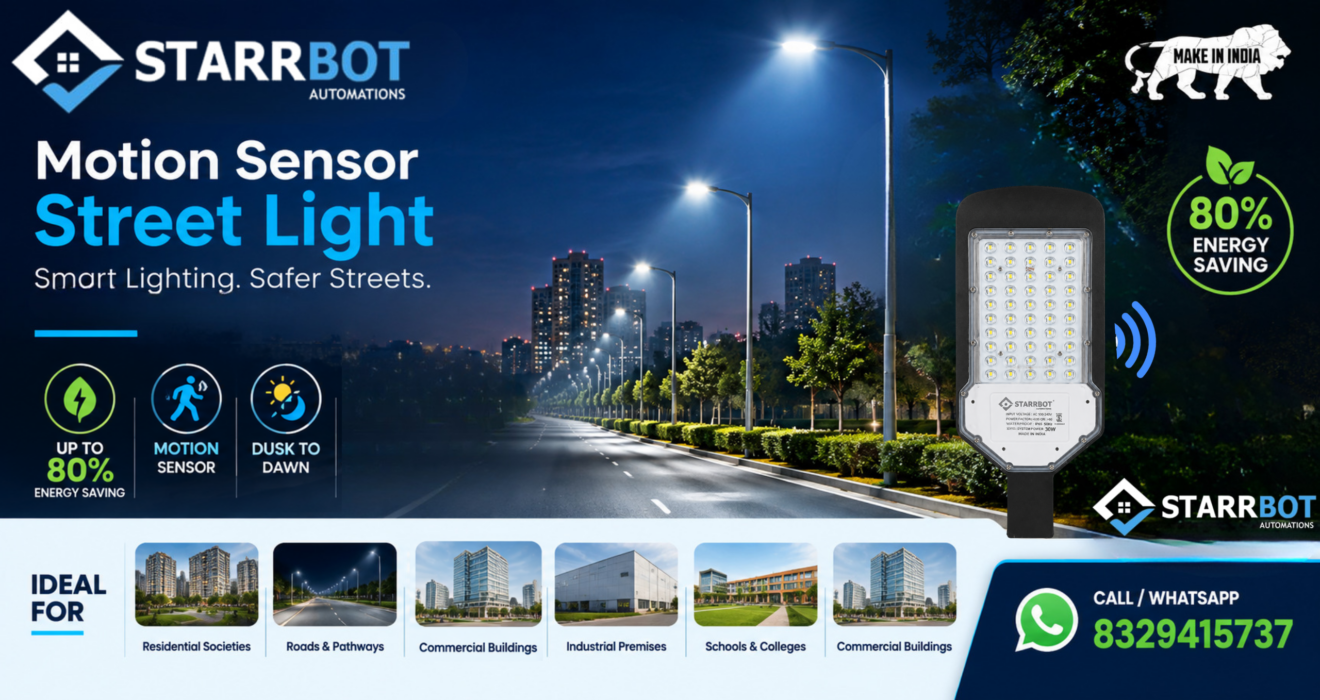
Buy Motion Sensor Street Light Online in India: A Practical Buying Guide
Walk up to your gate at midnight with your hands full, and the path lights up the moment you step onto the driveway. No switch, no fumbling, no dark corners. That is what a good motion sensor street light does — and buying one online in India is straightforward once you know which specs actually matter.
This guide covers how to choose the right wattage for each zone, the difference between PIR and microwave sensors, what IP rating you need for Indian weather, how auto dimming cuts your electricity bill, and what to check before you order online.
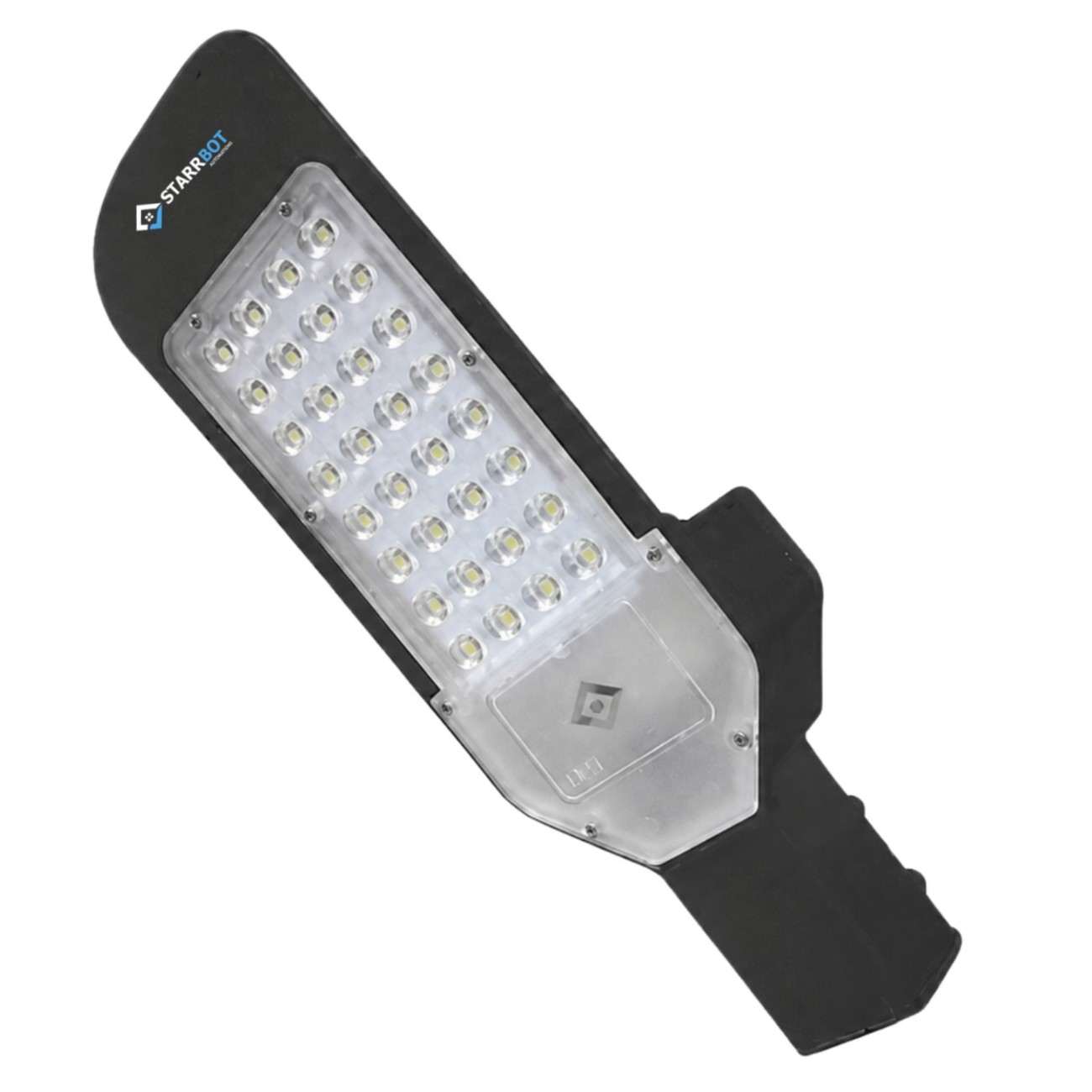
Why a Motion Sensor Street Light?
Lights that burn all night in empty driveways, parking bays and side lanes waste electricity every single day. A motion sensor street light runs at a low dim level when the area is empty and jumps to full brightness the instant it detects movement — so you get security and visibility exactly when needed, without paying for light nobody uses.
Depending on the model and dimming profile, this approach can cut energy use by up to 80% compared with a light that runs at full power all night. There is also a safety benefit: sudden full brightness startles intruders and guides family members, delivery staff and drivers after dark — with zero change in anyone’s habits.
Match the Wattage to Your Zone
The most common buying mistake is choosing by wattage alone. Think in terms of the area you need to cover:
- 24W to 36W — home gates, driveways, garden paths, narrow lanes and small society entrances.
- 50W to 72W — larger parking areas, courtyards, farmhouse entrances and society internal roads.
- 100W to 150W — community roads, industrial gates, school and hospital perimeters.
- 200W — main roads, highway stretches, large commercial or industrial premises.
If you are unsure, measure the area and the mounting height. A light mounted higher needs more wattage to deliver the same brightness on the ground. When in doubt, ask the manufacturer — a responsible seller will recommend the lower option that genuinely covers your zone rather than upselling.
PIR vs Microwave Sensors: Which One Do You Need?
PIR (passive infrared) sensors detect heat movement — people, animals, vehicles. They are reliable, energy-efficient and the standard choice for most homes and streets. They need a clear line of sight and work best mounted at the recommended height.
Microwave sensors emit low-power radio waves and detect motion through slight disturbances — they can sense through thin partitions and around slight obstructions, and cover wider angles. They are more sensitive, which suits large open areas but may need tuning near busy roads.
Dual-tech models combine both and only trigger when both sensors agree — the best choice for high-wattage installations where false triggers are costly or annoying.
IP Rating and Build Quality for Indian Conditions
Outdoor lights in India face monsoon rain, dust, heat and the occasional pressure-wash. Look for IP65 or IP66 as a minimum for street and gate lights — this means the unit is dust-tight and protected against strong water jets. An aluminium body dissipates heat far better than plastic, which directly extends LED life in Indian summers. Check that the mounting bracket is sturdy metal and that the warranty is stated clearly on the product page.
Auto Dimming: The Feature That Does the Saving
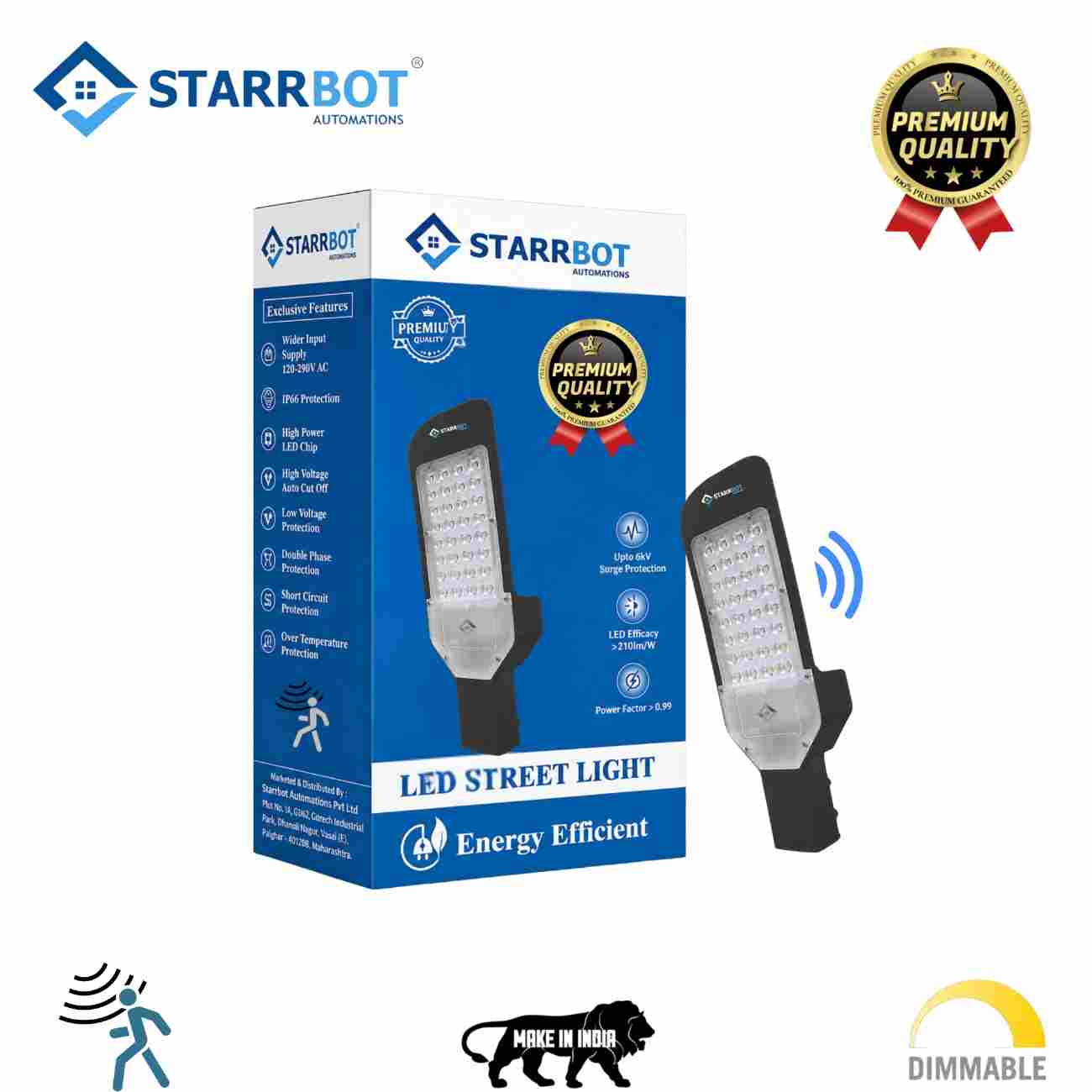
The real efficiency comes from the dimming profile. StarrBot street lights with auto dimming run at around 15% brightness when the area is empty and ramp to 100% on detection. A dusk-to-dawn photocell handles switching, so the light manages itself entirely. When comparing models online, look for the dimming ratio in the spec sheet — 100% to 15% is the profile to look for — rather than just the headline wattage.
Installation and Avoiding False Triggers
A few practical points save most post-installation complaints:
- Mount at the height recommended for your model — too high reduces detection, too low narrows coverage.
- Avoid pointing the sensor directly at busy roads, swaying branches or heat sources like AC outdoor units, which can cause false triggers.
- Angle the sensor head toward the approach path — the zone where people or vehicles actually enter.
- Use a qualified electrician for mains wiring, and test the detection zone at night before final tightening.
What to Check Before You Order Online
- Full spec sheet: wattage, lumens, sensor type and range, detection angle, IP rating, dimming ratio, body material.
- Warranty and support: a clear warranty period and a reachable support channel matter more than a small price difference.
- Who you are buying from: buying direct from the manufacturer gives you genuine stock, technical guidance for your zone, and straightforward warranty claims.
- Delivery and replacement terms: check the stated policy before paying, especially for higher-wattage units.
The StarrBot Range
StarrBot designs and manufactures motion sensor lighting in India, with a street light range covering every zone above — all with auto dimming, IP-rated aluminium housings and direct-from-manufacturer support:
- 24W Motion Sensor Street Light — gates and driveways
- 36W Motion Sensor Street Light — lanes and society entrances
- 50W Motion Sensor Street Light — parking areas and courtyards
- 100W Motion Sensor Street Light — community roads and perimeters
- 200W Motion Sensor Street Light — main roads and large premises
Not sure which wattage fits your space? Talk to the StarrBot team with your area size and mounting height, and we will recommend the right model.
Frequently Asked Questions
Do motion sensor street lights really save electricity?
Yes. By dimming to around 15% when an area is empty and brightening only on detection, sensor street lights can reduce energy use by up to 80% compared with lights running at full power all night.
What wattage do I need for my home gate or driveway?
For most residential gates, driveways and garden paths, 24W to 36W is sufficient. Larger parking areas and courtyards do better with 50W to 72W. Mounting height and area size decide the final choice.
What IP rating should an outdoor sensor light have in India?
Choose IP65 or IP66 for anything installed outdoors. It protects against monsoon rain, dust and jets of water, and is essential for a light expected to last several seasons.
Will pets or passing traffic keep triggering the light?
Correct mounting and aiming prevents most false triggers. Point the sensor at the approach path, away from busy roads and moving foliage. Dual-tech models further reduce unwanted triggers in demanding locations.
Is it better to buy direct from the manufacturer?
Buying direct gives you genuine products, guidance on the right model for your zone, and a direct line for warranty and support — advantages marketplaces cannot always offer.