Motion Sensor Lights: A Smarter Way to Save Energy
Lighting is an essential part of every building, but lights that remain ON in empty areas can lead to unnecessary electricity consumption. Motion Sensor Lights provide a smarter solution by automatically controlling lighting based on movement in the area.
These lights are useful for offices, IT parks, schools, hospitals, commercial buildings, parking areas, corridors and residential societies where lights are frequently used throughout the day.
This blog post dives into the world of motion sensor, highlighting the importance of these sensors and introducing StarrBot as a reliable name in the industry.
What Are Motion Sensor Lights?
Motion Sensor Lights are lighting systems that use sensors to detect movement in a particular area. When movement is detected, the light can automatically turn ON or become brighter. When the area is vacant, depending on the product and configuration, the light can turn OFF or reduce its brightness.
This helps prevent lights from operating at full brightness when they are not required.
How Do Motion Sensor Lights Save Energy?
Traditional lights may remain ON even when nobody is using the area. In large buildings with hundreds of lights, this can result in significant energy consumption.
Motion sensor lighting helps by:
Detecting movement automatically
Turning lights ON when required
Reducing unnecessary lighting
Supporting automatic dimming in compatible products
Reducing electricity consumption
Improving overall lighting efficiency
For large buildings, even a small saving per light can become a significant monthly saving when hundreds of lights are installed.
Real Customer Saving Example
A real-world installation demonstrates the potential of smart lighting.
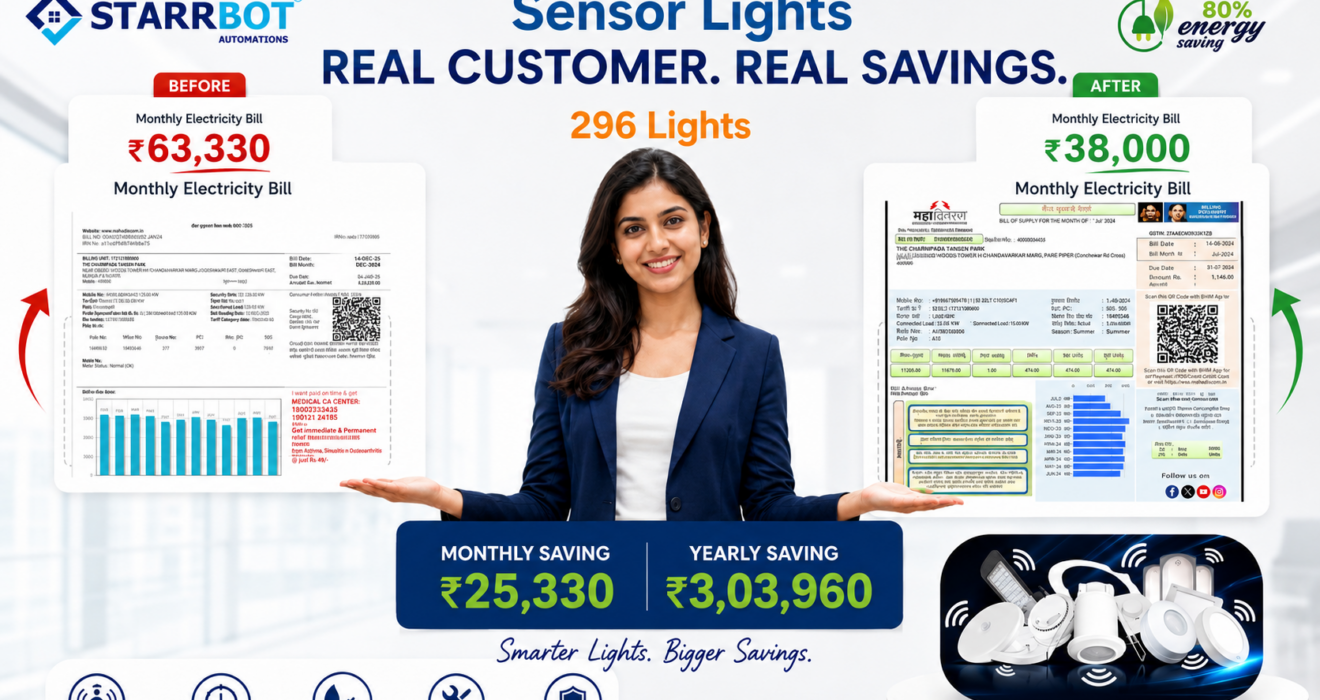
In one customer application, 296 lights were involved in the lighting system.
Before Motion Sensor Lighting
Monthly Electricity Bill: ₹63,330
After Motion Sensor Lighting
Monthly Electricity Bill: ₹38,000
Result
Monthly Saving: ₹25,330
Yearly Saving: ₹3,03,960
Actual savings can vary depending on operating hours, number of lights, installation conditions and usage patterns.
Motion Sensor Lights vs Traditional Lights
Traditional Lighting
Motion Sensor Lights
Lights may remain ON continuously
Lighting responds to movement
More unnecessary energy usage
Better energy efficiency
Manual control may be required
Automatic operation
Difficult to manage large areas
Easier automated control
Limited lighting automation
Supports smart lighting
Where Can Motion Sensor Lights Be Used?
Motion sensor lighting can be used in many different areas, including:
Offices
Automatically control lights in work areas, cabins, passages and common spaces.
IT Parks & Commercial Buildings
Large buildings can benefit from automated lighting in corridors, parking areas and common spaces.
Schools & Institutions
Motion-based lighting can help reduce unnecessary energy consumption in classrooms, corridors and washrooms.
Hospitals
Sensor-based lighting can be useful in corridors, utility areas and other suitable spaces.
Parking Areas
Lights can become brighter when movement is detected and reduce brightness when the area is vacant, depending on the product.
Residential Societies
Common areas such as staircases, corridors, lobbies and parking areas can use automatic sensor lighting.
Auto ON/OFF and Auto Dimming Are Not the Same
It is important to understand that automatic ON/OFF and automatic dimming are two different lighting functions.
An Auto ON/OFF Motion Sensor Light turns the light ON when movement is detected and OFF when the area becomes vacant.
An Auto-Dimming Motion Sensor Light can adjust brightness based on movement and the product’s programmed dimming function.
STARRBOT offers different sensor-based lighting solutions depending on the application’s requirements.
Benefits of Motion Sensor Lights
Energy Saving
Lights operate according to actual usage, helping reduce unnecessary electricity consumption.
Automatic Operation
There is less dependency on manually switching lights ON and OFF.
Better Convenience
Lights can respond automatically when people enter or move through an area.
Smart Building Management
Sensor lighting can become an important part of modern building automation.
Lower Operating Cost
Reducing unnecessary lighting operation can help lower electricity expenses over time.
Why Choose STARRBOT Motion Sensor Lights?
STARRBOT provides smart lighting and sensor solutions designed for homes, offices, commercial buildings and other applications.
Our solutions focus on:
Motion detection
Automatic lighting control
Auto-dimming options
Energy-efficient operation
Easy installation
Long-life lighting solutions
For more information, explore our Motion Sensors and choose the right sensor solution for your application.
Conclusion
Motion Sensor Lights are an effective way to make lighting smarter and more energy efficient. Instead of keeping lights at full brightness when they are not needed, sensor-based lighting can automatically respond to movement and usage.
The example of 296 lights reducing the monthly electricity bill from ₹63,330 to ₹38,000 demonstrates the potential impact of smart lighting in large installations.
For offices, commercial buildings, parking areas, schools, hospitals and residential societies, switching to smart Motion Sensor Lights can be a practical step toward better lighting and lower energy consumption.
STARRBOT – Smart Lights. Better Savings.
CTA: Want to reduce unnecessary lighting costs? Contact STARRBOT today for smart Motion Sensor Lights and energy-efficient lighting solutions.